Automation Platform > Architecture
Data security and boundaries
# Data security and boundaries Every run moves a few distinct classes of data, and each class has its own boundary. This page maps them across the three zones involved: your infrastructure, the Warp platform, and model providers. All communication is encrypted in transit (TLS 1.2+), all stored data is encrypted at rest (AES-256), and known secret values are redacted at output boundaries.  ## The data classes 1. **Source code** - For Warp-hosted runs, repositories are cloned into an isolated per-run sandbox and destroyed with it; Warp does not persistently store your source code or train on it. For [self-hosted execution](/platform/self-hosting/), checkout and the workspace stay on your infrastructure, and the worker's connection to Warp is outbound-only. Either way, code context the agent puts into prompts and transcripts still transits Warp. 2. **Prompts and context** - The agent's model calls route through Warp's inference routing to LLM providers under [Zero Data Retention](/enterprise/security-and-compliance/security-overview/#zero-data-retention-zdr) agreements: providers don't retain or train on the traffic, except for provider-specific models the ZDR terms don't cover. 3. **Run data** - Transcripts, artifacts, run metadata, and costs persist in Warp's stores, encrypted at rest and access-controlled by your team's roles. Enterprise teams can additionally export the supported classes — transcripts, artifacts, and run attachments — to a customer-owned Amazon S3 or Google Cloud Storage bucket; Warp retains the primary run record, configuration, and other control-plane state. 4. **Execution secrets** - [Managed secrets](/platform/secrets/) are stored encrypted and injected into the sandbox at runtime, scoped by allowlist to the runs that need them. [Secret redaction](/support-and-community/privacy-and-security/secret-redaction/) at output boundaries is a backstop, not a substitute for narrow scopes and rotation. 5. **Inference credentials** - Model provider keys are used only at the inference boundary and are never injected into sandboxes. With [Bring Your Own LLM](/enterprise/enterprise-features/bring-your-own-llm/), inference routes through your own provider account, so billing and provider-side retention follow your contract. 6. **Repository identity** - Agents check out and push with scoped repository credentials, and pull requests are attributed to the creating user or to the agent itself depending on the configured [credential strategy](/factories/factory-as-code/#credentialstrategy). Branch protection and repository permissions apply as usual. ## With self-hosted execution [Self-hosted execution](/platform/self-hosting/) moves the execution boundary: checkout, builds, and command execution stay on your infrastructure, and no Warp-hosted sandbox is involved. The control plane still holds orchestration, session data, run records, and inference routing, and an optional customer-owned bucket can hold an exported copy of run data.  ## Related pages * [Security overview](/enterprise/security-and-compliance/security-overview/) - Encryption, ZDR, compliance, and data handling in full. * [Self-hosting security and networking](/platform/self-hosting/security-and-networking/) - The data model for self-hosted workers. * [Warp Factories infrastructure and security](/factories/infrastructure-and-security/) - The same boundaries applied to factories.Tell me about this feature: https://docs.warp.dev/platform/architecture/data-security-boundaries/Where code, prompts, run data, secrets, and credentials flow across customer infrastructure, the Warp platform, and model providers.
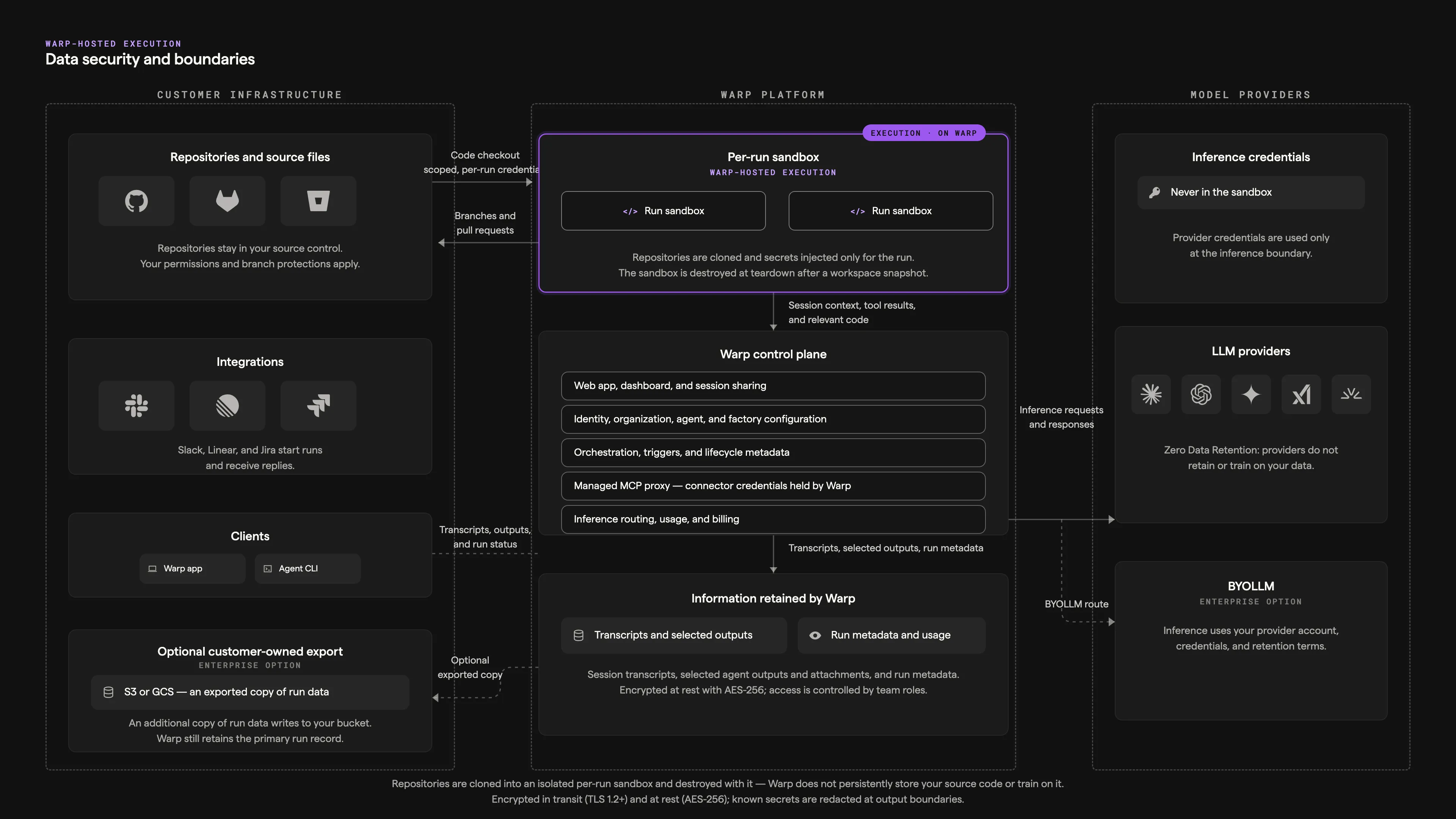
Every run moves a few distinct classes of data, and each class has its own boundary. This page maps them across the three zones involved: your infrastructure, the Warp platform, and model providers. All communication is encrypted in transit (TLS 1.2+), all stored data is encrypted at rest (AES-256), and known secret values are redacted at output boundaries.
The data classes
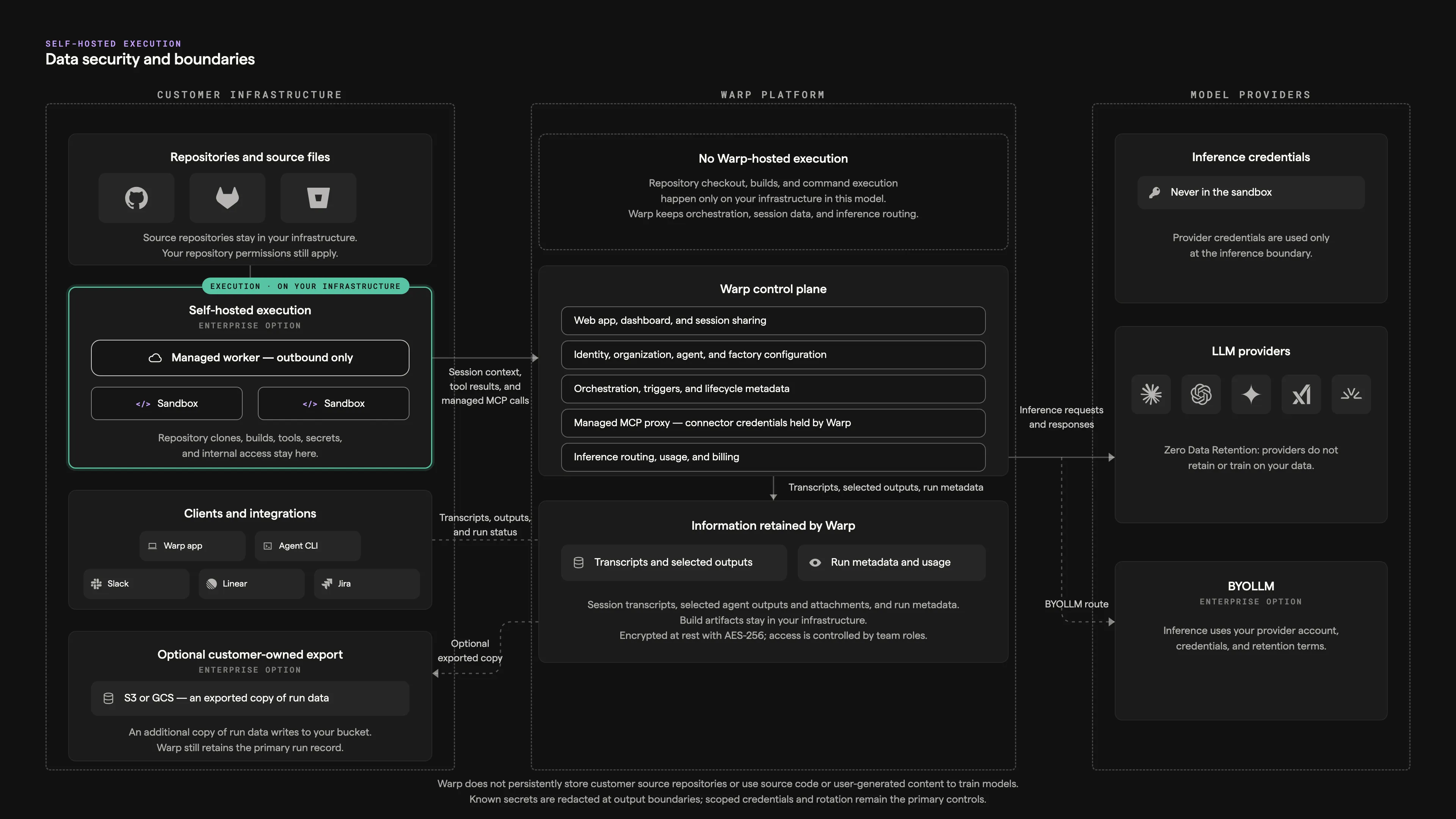
Section titled “The data classes”- Source code - For Warp-hosted runs, repositories are cloned into an isolated per-run sandbox and destroyed with it; Warp does not persistently store your source code or train on it. For self-hosted execution, checkout and the workspace stay on your infrastructure, and the worker’s connection to Warp is outbound-only. Either way, code context the agent puts into prompts and transcripts still transits Warp.
- Prompts and context - The agent’s model calls route through Warp’s inference routing to LLM providers under Zero Data Retention agreements: providers don’t retain or train on the traffic, except for provider-specific models the ZDR terms don’t cover.
- Run data - Transcripts, artifacts, run metadata, and costs persist in Warp’s stores, encrypted at rest and access-controlled by your team’s roles. Enterprise teams can additionally export the supported classes — transcripts, artifacts, and run attachments — to a customer-owned Amazon S3 or Google Cloud Storage bucket; Warp retains the primary run record, configuration, and other control-plane state.
- Execution secrets - Managed secrets are stored encrypted and injected into the sandbox at runtime, scoped by allowlist to the runs that need them. Secret redaction at output boundaries is a backstop, not a substitute for narrow scopes and rotation.
- Inference credentials - Model provider keys are used only at the inference boundary and are never injected into sandboxes. With Bring Your Own LLM, inference routes through your own provider account, so billing and provider-side retention follow your contract.
- Repository identity - Agents check out and push with scoped repository credentials, and pull requests are attributed to the creating user or to the agent itself depending on the configured credential strategy. Branch protection and repository permissions apply as usual.
With self-hosted execution
Section titled “With self-hosted execution”Self-hosted execution moves the execution boundary: checkout, builds, and command execution stay on your infrastructure, and no Warp-hosted sandbox is involved. The control plane still holds orchestration, session data, run records, and inference routing, and an optional customer-owned bucket can hold an exported copy of run data.
Related pages
Section titled “Related pages”- Security overview - Encryption, ZDR, compliance, and data handling in full.
- Self-hosting security and networking - The data model for self-hosted workers.
- Warp Factories infrastructure and security - The same boundaries applied to factories.